Can the old tiles go back on?
Replacing worn underlayment does not always mean replacing every tile. We look at tile condition, removal damage and replacement availability before recommending whether your old tiles should go back on.
By the USA Roofing team · · 5 min read

Keeping the tile is sometimes an option
Yes, sound roof tiles can sometimes go back on after we replace the underlayment. The work is commonly called a lift-and-relay: we remove the existing tiles, set aside suitable pieces, replace the worn waterproofing beneath them and reinstall the reusable tile with an appropriate attachment system.
That does not mean every tile roof is a good candidate. Tiles that look fine from the driveway may have damaged edges, cracks underneath or attachments that make removal difficult. A plan to reuse them needs to account for what happens when they are actually lifted.
We often see South Florida homeowners facing this decision because they like their roof's appearance and the tiles still look serviceable. Our article on worn waterproofing beneath tile explains that mismatch. Here, the question is whether saving the covering makes practical sense once the work underneath is necessary.
We check whether the tiles can survive removal
Age alone does not settle the decision. We look at the condition of the tile itself, including cracking, crumbling edges, surface deterioration and damage around attachment points. Concrete and clay tiles need individual evaluation, not a blanket assumption that old means unusable.
A brittle tile may stay in place without obvious trouble but crack when it is lifted, carried or reset. Existing mortar or adhesive can complicate removal. Mechanical fasteners also need careful handling, especially where the surrounding tile is already weakened.
We also look beyond the broad roof slopes. Ridge caps, hip tiles and pieces cut around valleys or roof penetrations may be harder to salvage or replace. Keeping the field tiles does not solve a shortage of the special pieces needed to finish the roof.
A reuse proposal should explain how tile condition is assessed and how damaged pieces are rejected. It should also acknowledge that the full extent of breakage cannot be known before removal. Do not climb onto the roof to test a tile yourself. Leave that assessment to the crew handling the work.
A similar-looking replacement may not fit
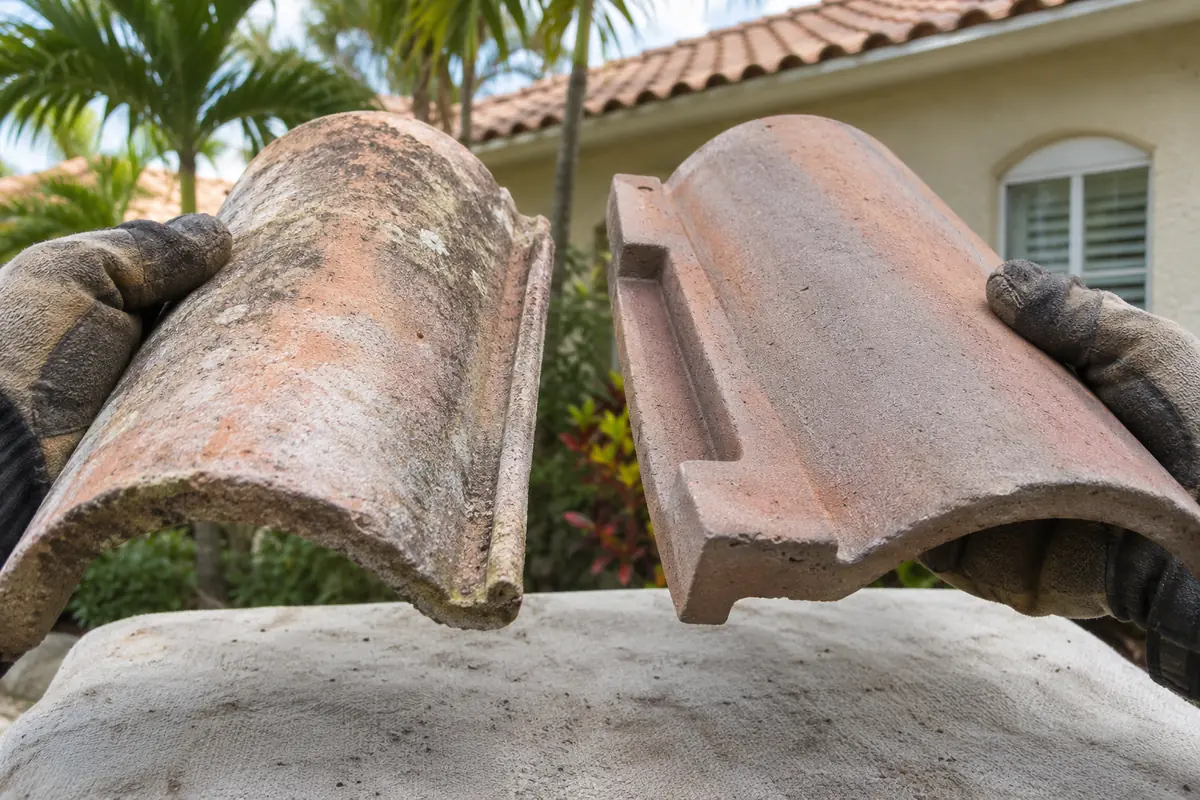
Before we recommend keeping old tiles, we need a workable source of compatible replacements. Discontinued profiles are a particular concern on older South Florida homes. A tile with a similar barrel shape may have different side interlocks, overlaps or attachment details.
Color is only part of the match. A replacement needs to seat correctly with the existing tiles and be suitable for the proposed roof assembly. Forcing a close-looking piece into place is not a sound substitute for checking compatibility.
Appearance deserves a separate conversation. Existing tiles have weathered in the sun and rain. A newly made tile in a similar color may stand out. Salvaged pieces can differ too, and their condition and suitability still need checking.
Ask us to show you the proposed replacement beside your existing tile when a sample is available. Check the view from the yard as well as the close-up appearance. If your association reviews exterior changes, ask your association about its requirements before choosing replacement tile or accepting a visible mismatch.
Breakage needs a plan before work starts
Careful removal can reduce avoidable damage, but it cannot eliminate breakage. Tiles may crack as attachments are released. Others may reveal hidden damage during handling. Some pieces that survive lifting may still be unsuitable for reinstallation.
That is why we do not treat a neat stack of saved tiles as proof that the roof can be completed with them. The plan needs enough suitable material for the roof layout, including cuts and finishing pieces, with a reserve for breakage.
Before accepting a lift-and-relay scope, ask:
- Which existing tiles are considered suitable for reuse?
- Where are compatible replacement tiles coming from, and has availability been checked?
- How are saved tiles handled and stored without overloading the roof?
- What happens if removal leaves too few usable pieces?
- How are changes to the agreed scope documented and approved?
A vague promise to find matching tiles later leaves an important decision unresolved. If suitable replacements are scarce, that problem belongs in the discussion before the roof is opened.
New underlayment still means substantial roof work
Even when the underlayment is the apparent failure, lifting the tile creates an opportunity to inspect the roof deck and surrounding details. Deteriorated decking, damaged flashing or unsuitable existing attachments can change the scope. Keeping the tile does not mean keeping everything beneath it.
The proposal should identify the underlayment system, flashing work, tile attachment method and how concealed damage is handled. It should also explain temporary weather protection while the roof is open. South Florida rain does not wait for a convenient stopping point.
Do not assume reused tile removes the need for permits or inspections. Check with your building department about the proposed work. We handle permits, engineering and inspections for our roofing projects, and we establish the proposed assembly before recommending a reuse approach.
For a condo, confirm who is responsible for the roof and who can authorize the work. Ask your association about project approval, access and material requirements before arranging a scope for an individual unit.
Choose the approach the roof can support
Lift-and-relay is worth considering when the existing tiles are sound, removal appears practical, compatible replacements are available and the proposed assembly is acceptable for the project. It can preserve a roof appearance you want to keep without discarding serviceable tile.
New tile deserves serious consideration when existing pieces are brittle, matching profiles cannot be sourced or removal damage could leave the project short of usable material. It may also make sense if you want a consistent appearance instead of mixing weathered tile with replacements.
Ask for the approaches to be compared using the same underlying work. Deck repairs, underlayment, flashing, attachments and inspections should not disappear from the comparison just because one option uses new tiles. We use our own crews and can explain what each approach includes before you decide.
Start with a roof assessment and a written scope. Request a free roof estimate or call (954) 637-7029.