Why your tile roof leaks without broken tiles
Intact tiles do not rule out a roof leak. We look beyond the tile surface, checking drainage paths, concealed waterproofing and flashing to find where water enters and how it reaches your ceiling.
By the USA Roofing team · · 5 min read

The ceiling stain is a clue, not a location
You notice a brown mark on the ceiling, then look outside and see a roof full of tiles that appear intact. That does not rule out a roof leak. The opening may be beneath the tiles or at a connection that is difficult to see from the ground.
Water does not always fall straight from that opening onto your ceiling. It can follow the underside of roof decking, run along framing or travel down a pipe before dripping. Insulation can absorb water and release it somewhere else. The visible stain may be downhill or sideways from the entry point.
We use the stain to start tracing that path, not to choose a repair location by itself. Tell us whether it appears during steady rain, only during wind-driven rain or after the rain has stopped. Those details help guide the inspection, although none identifies the cause on its own.
Aged underlayment can leak beneath intact tile
Tile sheds much of the rain that reaches your roof, but the covering is not a sealed surface. Underlayment beneath it provides a water-shedding layer for moisture that gets past the tile. That concealed layer can deteriorate while the visible tiles remain intact.
At an exposed inspection area, we may find brittle material, separated seams or damage around an attachment. The important question is not simply whether the material looks old. We need to establish whether a defect connects to the water path inside your home.
Our article on worn waterproofing hidden beneath tile explains that concealed layer in more detail. For an active leak, we also need to check nearby drainage and flashing. Finding aged underlayment does not mean every stain comes from it, or that replacing a small exposed patch addresses the whole problem.
Packed valleys can interrupt the drainage path
A valley is the channel where roof slopes meet. It collects runoff from the surrounding roof, so a restriction there deserves attention even when the adjacent tiles look sound.
We often see leaves, palm debris and small branches collect near valleys on South Florida homes. Material can lodge beneath tile edges as well as in the visible channel. A valley that looks open from the driveway may still have an obstruction farther up the slope.
Packed debris can hold moisture and interfere with drainage. Depending on the valley detail and the location of the blockage, water may be diverted toward tile edges or vulnerable connections. We check both the obstruction and the condition of the materials beneath it.
Clearing debris and repairing a leak are not necessarily the same job. Removing a blockage may restore drainage, but damaged valley metal or deteriorated adjoining underlayment may still need work. Stay on the ground rather than climbing onto tile to investigate or pulling debris out with a long tool.
Check where the roof meets walls and vents
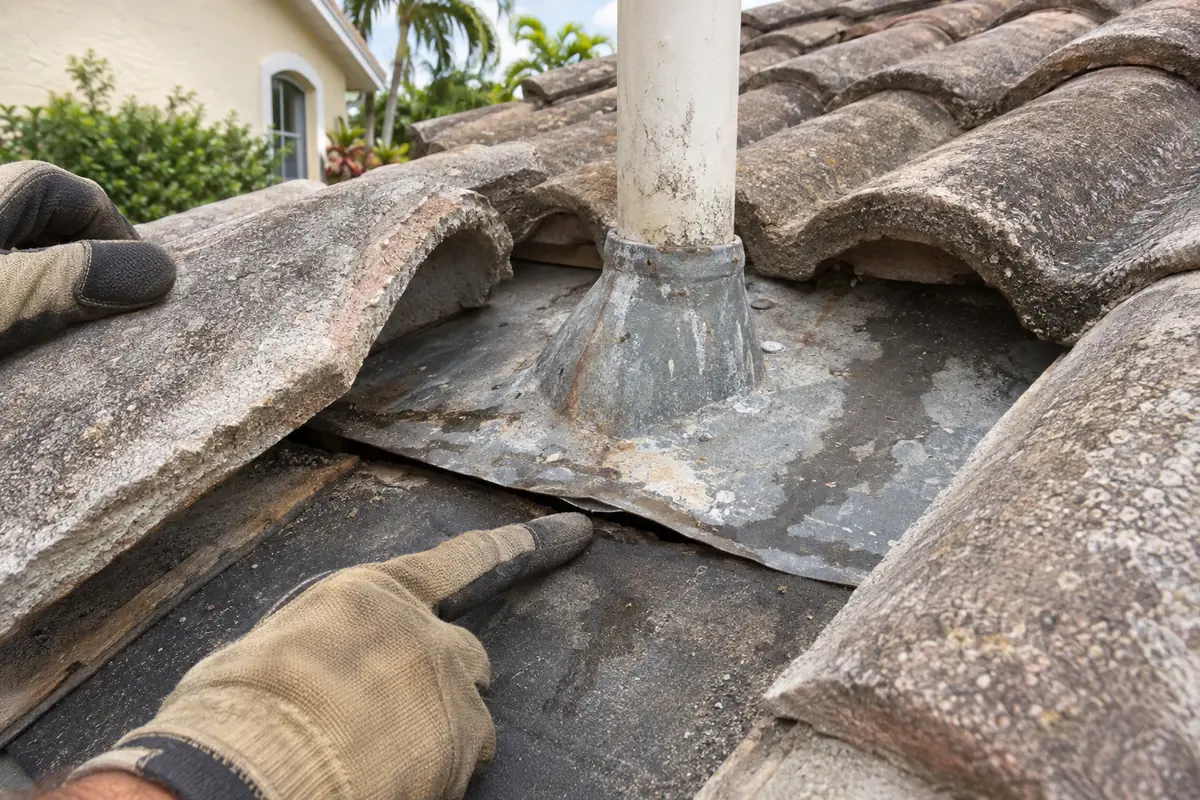
Flashing directs water around places where the roof meets something else. On a tile roof, that includes wall intersections and plumbing vents. These connections can leak without any broken field tiles, which are the tiles covering the main roof slopes.
At a wall, we look at how the flashing connects with the roof covering and the wall finish. An exposed bead of sealant does not show whether the concealed overlaps are arranged correctly. Water entering higher on a wall can also complicate the diagnosis, so we do not assume every nearby ceiling stain starts in the roof covering.
At a plumbing vent, we check the flashing around the pipe and how it joins the surrounding roofing. A split component, an open connection or an old patch may provide a path beneath otherwise intact tiles.
We also look for earlier repairs. Surface sealant may cover the visible gap while leaving the underlying defect unresolved. Adding more material without understanding the detail can conceal evidence or interfere with drainage.
Give the inspection a useful starting point
You can help us trace the leak without getting onto the roof. Keep a short record of what you see indoors and what the weather was doing when it happened.
- Photograph the stain and include enough of the room to show its location.
- Note whether the area is damp, actively dripping or dry between rain events.
- Record whether nearby stains appear together or at different times.
- Share any available roof repair records and describe previous attempts to stop the leak.
- Keep access clear beneath an attic opening, but leave entry into a wet or difficult attic to the inspector.
When accessible and safe, an attic inspection can help connect interior water marks with exterior roof details. We compare those clues with the valley, wall and vent locations outside. Selective tile removal may be needed to inspect concealed materials.
A stain alone is not proof of a roof leak. Plumbing or air-conditioning condensate can produce similar marks. If the evidence does not point to the roof, that needs to be part of the explanation.
Match the repair to the evidence
A useful repair proposal should identify the suspected entry point, describe the evidence and explain what needs to be exposed or replaced. Ask how the proposed work addresses the route water is taking, not just the spot where it becomes visible.
A localized flashing defect may call for a targeted repair. Deterioration extending beyond the inspection opening may require a broader scope. Intact tiles alone cannot settle that decision. We need to consider the concealed materials, surrounding connections and whether the repair can tie into sound roofing.
If you own a condo, ask your association who coordinates roof access and repairs. For work requiring permits, check with your building department about the applicable process. Our own crews perform the roofing work, and we handle permits, engineering and inspections as the scope requires.
Arrange a free roof estimate or call (954) 637-7029 so we can inspect the roof and discuss the next step.