Concrete or clay tile on your Florida roof
A barrel-shaped roof tile is not necessarily clay. We explain what separates concrete from clay, how each changes in South Florida weather, and where to look before choosing a replacement.
By the USA Roofing team · · 5 min read

A barrel shape does not mean clay
The reddish barrel tiles on your house might be concrete, not clay. Both materials can have rounded profiles, flat faces and blended colors. From the driveway, they can look remarkably similar.
Concrete tile is common across South Florida neighborhoods, including planned communities in Miami-Dade, Broward and Palm Beach counties. Clay also appears on Mediterranean-style homes and older properties. But the neighborhood, house style and roof color are clues, not proof of what you have.
We start with the actual tile and any available roof records. That matters whether you need a replacement for a cracked piece or are choosing a new roof. Matching the shape and material comes before matching the color. A similar-looking tile may not fit the surrounding courses.
How the color changes over time
Concrete tiles are molded from cement, sand and water. Pigments can color the body, and factory-applied surface finishes can create additional colors or blends. Not every concrete tile has the same kind of finish.
Under South Florida sun and rain, the appearance can soften. Depending on the tile, surface weathering may make the original color less pronounced or expose more of the underlying concrete. A shaded slope can also look different from a sunnier slope because of surface growth and accumulated dirt.
Clay tiles are shaped and fired in a kiln. Their color comes from the clay and firing process, sometimes with an added fired finish or glaze. Natural terracotta often retains its basic color well, although dirt, surface growth and weathering can still change how the roof looks.
Neither material stays looking freshly installed indefinitely. A lighter patch does not automatically mean failing tile, and a dark patch does not identify the material. Before choosing cleaning, coating or replacement work, we separate surface discoloration from actual damage.
If you are matching replacement tiles, compare samples outdoors beside the existing roof. A new tile can fit correctly and still stand out against weathered material. Ask to see the proposed match before the repair begins.
What texture and shape can tell you
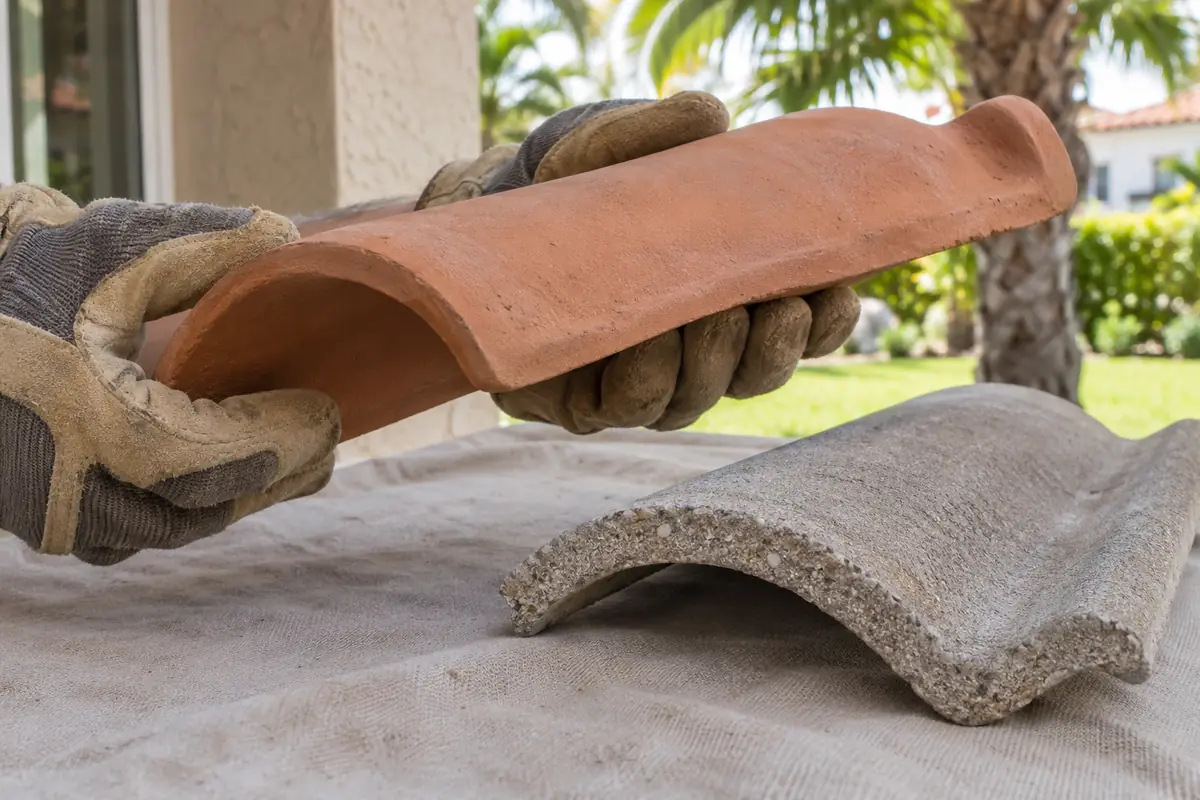
Concrete often has a cement-like, slightly sandy texture, especially where the surface has weathered. It can also have a smooth finish or a deliberately textured face. Clay may have a smoother fired surface, a matte finish or a glossy glaze. Rustic clay can be uneven rather than polished.
We look at the surface together with the edges and underside. A previously broken concrete tile may reveal a granular interior. A clay fragment may show a finer ceramic body. These are useful clues, but finishes and manufacturing differences can make identification less obvious.
Shape alone is unreliable. Both materials come in curved and flat profiles. A flat tile roof is still a pitched tile roof, not the same thing as a low-slope membrane roof.
For appearance, look beyond the individual sample. Rounded profiles cast deeper shadows. Flat profiles create straighter lines. A blended roof has more variation across the surface than a uniform color. Our tile roofs overview is a starting point, but we recommend comparing actual samples against your stucco and trim in daylight.
Weight needs a product-specific answer
Both concrete and clay are heavy roofing materials. Standard concrete tile is often heavier than comparable clay tile, but that is not a rule you should use to approve a roof change. Profile, thickness and the installed tile layout all affect the load.
Holding a spare tile in your hands does not tell you what the finished roof weighs. Different products cover different amounts of roof, and the complete assembly matters.
If you are switching materials, we check the proposed product against the existing roof structure and project requirements. Do not assume that a house with clay can accept any concrete tile, or that changing to clay automatically removes the need for a structural review.
For a reroof, ask which exact tile is being proposed and whether the scope includes the necessary engineering, permits and inspections. We handle that work as part of our roofing projects. If you need clarification about local requirements, check with your building department.
How to identify your tile without climbing
You do not need to walk the roof to start. Tile can crack under misplaced steps, and a dusty or damp surface can be slippery. Leave lifting installed tiles and checking their undersides to a roofer.
- Look for stored spares. A tile left in the garage can show the face, edge, underside and identifying marks. Do not break or scratch it to test the material.
- Find the roofing paperwork. An old contract, product approval or reroof record may identify the material and profile. A permit summary that only says tile may not be enough.
- Take photographs from the ground. Include the whole slope and a closer view of an accessible eave. Photographs help narrow the possibilities, though they may not settle the identification.
- Ask your association. It may have records of the approved roof material, profile and color. Confirm what applies to your property rather than relying on a neighbor's roof.
- Have the material confirmed before ordering. We check the tile itself and the available documentation before recommending a replacement.
If you are buying a home, request the roof records rather than relying on a listing description such as Spanish tile. That describes an appearance, not necessarily the material.
Choose a match, not just a similar color
For a repair, the replacement needs compatible dimensions, overlap and interlocking details, not just a close shade. Concrete and clay pieces are not interchangeable simply because they have similar curves. Availability also matters when an older profile is no longer produced.
For a full reroof, compare the material, finished appearance, structural requirements and association restrictions together. Ask your association about its review process before settling on a different profile or color.
Keep appearance separate from roof condition. Attractive tile does not establish the condition of the waterproofing beneath it. We cover that distinction in Your tile roof can hide worn waterproofing.
To identify your tile or compare reroof options, request a free roof estimate or call (954) 637-7029.