Choosing the look of your tile roof
A tile roof's shape changes how the whole house looks from the street. We explain barrel, S-tile and flat profiles, how to compare color blends, and what to gather before association review.
By the USA Roofing team · · 5 min read

Barrel tile gives the roof deeper shadows
On a South Florida stucco house, a rounded roof tile creates a different look from a flat tile, even in the same color. The curves catch sunlight along their tops and leave shadows beneath their edges. Before choosing a color, decide how much texture you want across the roof.
Traditional barrel construction uses separate curved pan and cover pieces. The pans form channels, and the covers sit over the joints between them. People also use barrel tile loosely to describe other rounded profiles, so we ask you to point to a sample or photograph rather than rely on the name alone.
That pronounced curve suits Mediterranean and Spanish-style houses, especially homes with arches, textured stucco and sheltered entries. Warm earth tones reinforce that traditional appearance. If your house has a broad roof visible from the street, remember that the repeating curves become a major part of the exterior, not just a detail along the edge.
S-tile creates a continuous rolling pattern
An S-tile combines a raised curve and a lower channel in the same piece. Across the roof, those shapes create repeating waves. It shares the rounded character associated with barrel roofs, but the pieces are formed differently.
We often see this profile on South Florida homes with stucco walls, hip roofs and covered patios. It can suit Mediterranean architecture or give a simpler house a softer roofline. Some profiles have a pronounced roll; others look gentler. Seeing them beside each other helps more than comparing profile names.
Look at the lower roof edge as well as the main slope. The exposed ends contribute to the finished appearance. Ask to see how the proposed tile looks at the eave, hips and ridge, where roof slopes meet. A photograph taken straight at the roof face may hide those details. Our tile roofs overview is a starting point for discussing the roof you have and the look you want.
Flat tile gives the roof straighter lines
Flat tile describes the tile's profile, not the slope of the roof. It still belongs on a roof designed for that tile system. It is not the same thing as a low-slope roof with a membrane covering.
Instead of rounded waves, you see horizontal courses and the lines where individual tiles meet. Smooth flat tiles can suit contemporary homes with simple shapes and restrained exterior colors. Textured versions can give a more traditional house a quieter roof surface without the pronounced curves of barrel or S-tile.
We suggest looking closely at the tile edges. A thicker-looking lower edge creates more shadow than a thinner-looking edge. Surface texture also changes the effect: smooth gray tile and textured gray tile can read quite differently from the driveway. Flat does not automatically mean sleek, and curved does not automatically mean rustic. The complete sample matters.
Profile and material are separate choices. Our article on concrete or clay roof tile explains that distinction without turning appearance into a material comparison here.
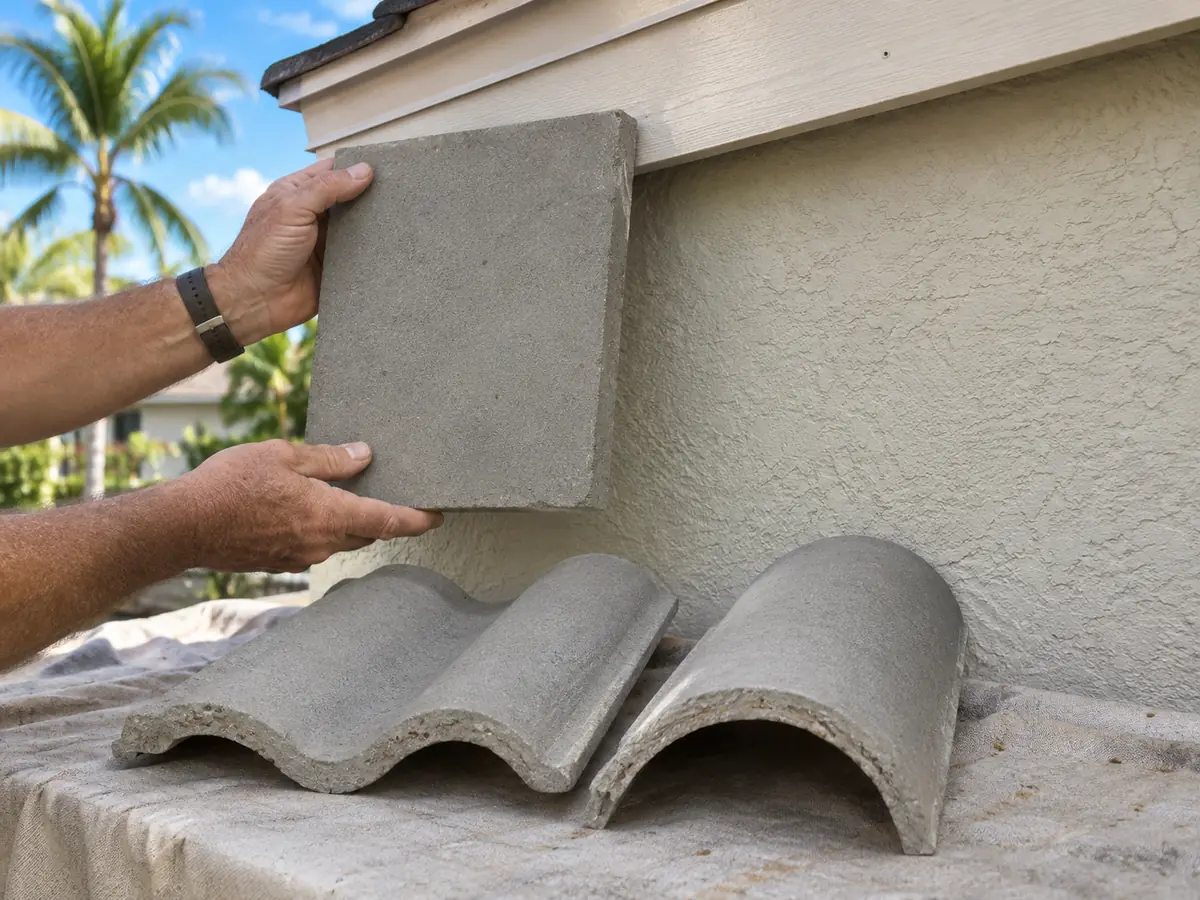
Compare color blends outside, against the house
A small sample can make a mixed-color roof look more uniform than it really is. A blend may combine muted background tones with noticeably lighter or darker tiles. Across a large roof, those differences become a pattern.
We recommend viewing a group of actual samples in daylight, beside your stucco and fascia colors. Then step back. Look in open sunlight and shade, because South Florida's bright light can make a warm neutral look pale and a dark blend look sharply contrasted.
- Warm blends: Terracotta, sand and brown can work with cream stucco and other warm exterior finishes.
- Cool blends: Gray and charcoal can suit white or cool-toned walls, but check whether the samples lean blue, brown or green.
- Subtle blends: Closely related shades create less visual variation across the roof.
- Contrasting blends: Strong light and dark differences make the roof more visually active.
These are visual starting points, not rules. Keep fixed finishes in mind, especially stonework and fascia you are not replacing. Do not judge a new sample solely against an old roof whose surface has weathered.
Ask your association for the exact selection requirements
South Florida associations may specify the roofing material, tile profile and approved color or blend. Some maintain a selection list; others ask for samples and review the proposed roof against the building's exterior. Ask your association for its current requirements before settling on a tile.
A neighboring roof is useful visual context, but it is not confirmation that the same selection is available or acceptable for your home. For an attached home or condo building, ask who coordinates the roof selection and whether adjoining roof areas need a consistent appearance.
For the appearance portion of the submission, gather:
- The exact tile product identification and profile.
- The proposed color or blend name, with physical samples if requested.
- Photographs of your existing roof and exterior finishes.
- Any requested details showing the eave, hip and ridge appearance.
If an older approved selection is unavailable, ask how to submit an alternative. Keep the written selection response with your roofing paperwork. Association review and building department approval serve different purposes; check with your building department about the roof permit requirements.
Choose the complete roof look before ordering
We find it helpful to narrow the profile first, then compare colors within that shape. Otherwise, a favorite color can distract you from curves or edges you do not actually like on your house.
Walk to the sidewalk and look back at your home. Notice how much roof you see, whether the entry already has strong architectural details, and how the roof meets the fascia. Review the proposed field tiles together with the matching hip and ridge pieces, not as separate decisions.
Appearance is only part of the selection. We also check whether the proposed tile system is appropriate for your roof and its installation requirements. A different profile is not automatically a direct replacement just because you prefer its look. Our own crews perform the work, and we handle permits, engineering and inspections.
Bring your exterior photos, preferred samples and association requirements to a free roof estimate. Call (954) 637-7029 to arrange the next step.