Check your roof after a hurricane safely
Your driveway and indoor rooms are the starting points for a roof check after a hurricane. We explain what you can spot safely, what photographs help, and when to request temporary protection today.
By the USA Roofing team · · 5 min read

Start where you can keep your feet on the ground
After a hurricane, your roof check starts with a safe place to stand, not a ladder. Wait until local conditions are safe and winds have settled. Look for downed wires, hanging branches, loose roof pieces and unstable gutters before walking around the house. If the route is unsafe, leave that side unchecked.
Use your phone's zoom or binoculars from the driveway or yard. Look at each visible roof slope from different ground positions without standing beneath damaged edges. Do not climb a fence, lean out of an upstairs opening or walk onto a lower roof for a better view.
The goal is to identify changes and decide what needs attention. A ground check cannot confirm that the roof is watertight or that its hidden attachments are intact. Tell us which areas you could not see, especially behind parapet walls or above an attached patio.
Look for gaps, shifted pieces and raised metal
On a tile roof, scan for broken barrel shapes, displaced rows and gaps that look different from the surrounding pattern. Check the ridge, where tile caps run along the roof's peak. Photograph tile fragments in the yard without handling sharp pieces or standing under loose material.
Tile is the visible covering, but the underlayment beneath it also matters. A missing tile does not tell you whether that layer is intact. Do not lift neighboring tiles to investigate.
- Shingle roofs: Look for bare patches, loose pieces and edges that appear raised. Our article on missing or lifted shingles after a storm explains those conditions and the repair questions they raise.
- Metal roofs: Look for panels that appear lifted or displaced and trim that is no longer sitting against the roof edge. Do not approach loose sheet metal.
- Flat roofs: Look only at edges and surfaces visible from safe locations. A straight parapet can hide damage behind it, so an apparently normal outline is not an inspection of the roof surface.
Flashing is the material that protects joints around roof penetrations, walls and edges. From the ground, you may notice a bent strip, an open-looking joint or metal hanging away from the house. Photograph it rather than trying to push it back.
Check debris, drainage and the roof's outline
We often see palm fronds and branches collect where roof slopes meet or where a sloped roof drains onto a flat section. Debris can hide damage and interfere with drainage. Photograph where it rests. Do not pull a branch off the roof from below or try to wash debris away with a hose.
Check visible gutter sections, downspouts and drainage openings through parapet walls. Note anything that appears crushed, detached or blocked. Water spilling from an unfamiliar location during later rain is also worth documenting from a sheltered, safe position.
Look along the ridge and roof edges for an unfamiliar dip, sag or change in shape. A ground view cannot establish the cause, and some roofs have older irregularities. A new sag, especially near a fallen limb or an indoor ceiling problem, needs urgent professional assessment. Keep people away from the area beneath it.
Leave roof debris removal to a crew equipped to assess the surface and work safely. Clearing a branch is not the first step if the decking underneath may be damaged.
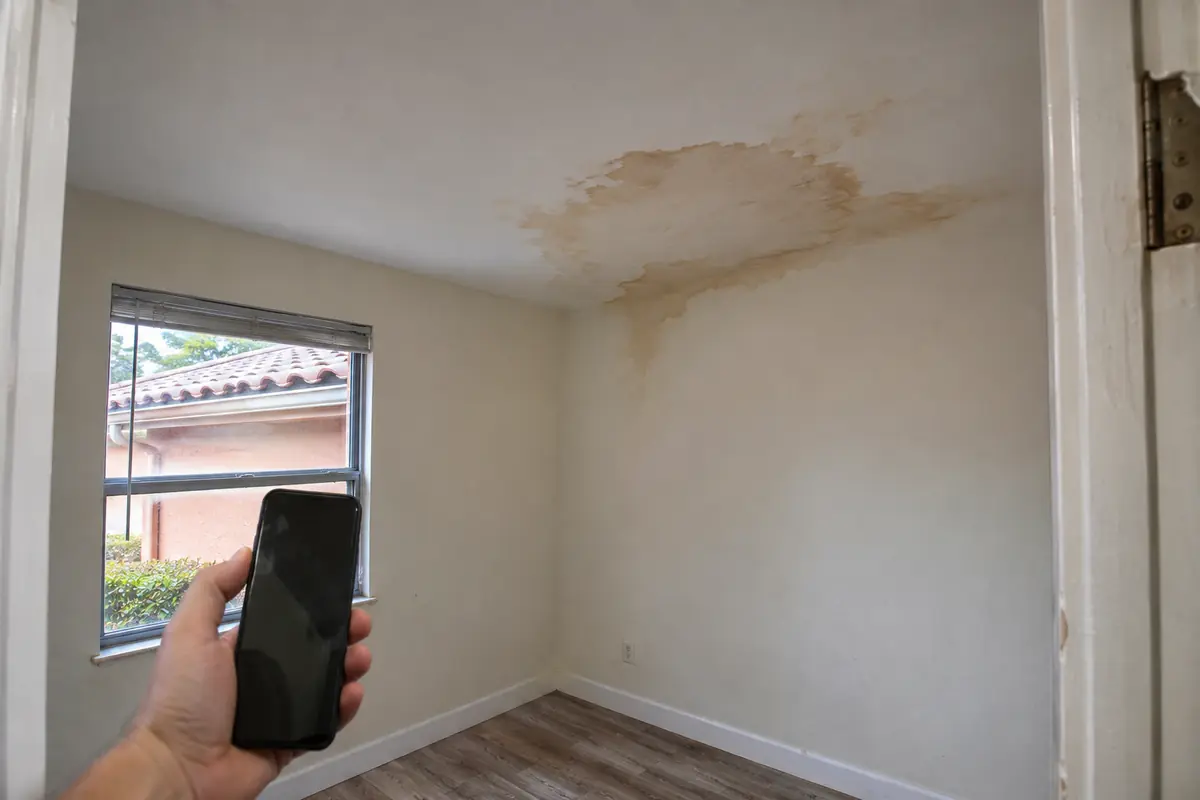
Check ceilings before considering the attic
Inside, walk through accessible rooms and look at ceilings, upper walls and the areas around roof penetrations. Check closets and rooms you rarely use. New brown marks, damp paint, bubbling finishes and dripping water are reasons to request an inspection, even when the roof looks unchanged outside.
Move belongings out of a wet area only if you can do so safely. Stay away from wet electrical fixtures, hanging ceiling material and bulging or sagging ceilings. Do not puncture a ceiling to release trapped water. Keep the affected room clear and request urgent help.
Checking the attic does not mean entering it after a storm. If you have a safely accessible opening, there is no water or electrical damage nearby, and you can look without climbing or entering, use a flashlight from the opening. Otherwise, leave the attic check to us.
Visible wet decking, damp insulation, water tracks and debris deserve attention. Light around a vent can be normal, so daylight alone does not establish storm damage. Do not step onto insulation or ceiling drywall, touch wiring or crawl toward a suspected leak. Water can travel along framing, so the ceiling stain may not sit directly below the roof opening.
Photograph locations, details and changes
Useful photographs connect the roof condition to a recognizable part of your house. Start with a wide view, then use zoom for the detail. You do not need roof-level photographs to request help.
- Outside: Capture the affected slope, missing material, lifted flashing, debris and any changed roofline.
- Inside: Take a room view and a closer photograph of each stain or leak, provided the area is safe.
- Your notes: Record the room or side of the house, when you noticed the condition and whether water entry is continuing.
- After temporary work: Keep the crew's photographs, description of the protection installed and written repair recommendations.
Save original files rather than only edited close-ups. Do not move debris or delay urgent protection to complete a photo record. Ask your insurance agent what documentation they need for questions about your policy.
Decide what needs temporary protection today
Active water entry, exposed decking, a visible hole or lifted roofing that leaves an opening calls for a same-day request for professional temporary protection. Missing covering also deserves prompt assessment because the condition underneath may not be visible from below. Do not wait for another rain to test it.
A sagging roof, unstable tree limb or wet electrical equipment needs urgent safety assessment before anyone attempts covering. Temporary protection is not simply throwing a tarp over the roof. Its placement and attachment depend on the roof material, damage and safe access. Do not climb up, add loose weights or drive fasteners through roofing yourself.
For a condo or association-managed property, ask your association who coordinates roof access and emergency work. We serve Miami-Dade, Broward and Palm Beach counties from Sunrise. Our own crews perform our roofing work, and we handle permits, engineering and inspections required for our projects.
Request a free roof estimate or call (954) 637-7029. Tell us right away if water is entering or the roof has an opening.